

Pier pricing and coverage
A downhill footing on pushed-in fill can need a long pier to reach firm ground, and pier depth never adds to your bill. The lifetime warranty on our steel piers transfers to the next owner if you sell.
On the eroded clay slopes that run down to Lake Acworth and Allatoona, downhill corners and brick chimneys sink toward the low side of the lot, and Anglin's pins them on steel piers driven to ground that holds.
Anglin's does foundation repair in Acworth, GA for houses built into the hills above Lake Acworth, Allatoona Creek and Proctor Creek. We drive steel push piers under settled footings and chimneys, brace cracked basement walls, and our own masons repair the brick afterward. Call our Marietta office at 770-422-2924 for a free estimate.
About six in ten Acworth houses went up between 1990 and 2009, and the city's median build year is 2000. The oldest streets are much older, with Victorian houses on Collins Avenue dating from about 1890 to 1910.
You're out on the back deck, on the side of the house that faces downhill, and the chimney next to you has a crack climbing from the ground toward the soffit. There's a gap between the brick and the siding wide enough to slide a pencil into. Downstairs, the door to the walk-out basement drags on its frame.
That low side is where houses on these hills tend to give. What you want to know is whether it's still moving and how much of the house went with it. We measure the gap and dig down to the footing before anyone talks about piers.
Olin L. Anglin started the company in 1930, and his family still runs it out of Marietta, in the same county as Acworth.
A downhill footing on pushed-in fill can need a long pier to reach firm ground, and pier depth never adds to your bill. The lifetime warranty on our steel piers transfers to the next owner if you sell.

Acworth's historic guidelines ask for matching mortar and a qualified mason. The crew that lifts your chimney repoints it.

Cracked 1990s veneer is sometimes broken wall ties, not a sinking footing. We tell you when piers aren't needed.

No subcontractors. Your estimator has done the work, and the two-page contract price is what you pay.
USDA soil maps put most of Acworth on Madison, Gwinnett, Appling and Pacolet soils, on slopes from gentle up to 25 percent, and about six in ten spots we sampled inside city limits are mapped as severely eroded, with clay close to the surface. That clay rates low for swelling and shrinking, so what moves a house here is weight resting on loose fill and water softening the clay on the low side. Our foundation repair starts by finding which one moved yours.
Many 1990s and 2000s Acworth houses sit on graded lots with the basement cut into the slope. The buried wall holds back soil, while the downhill footings, stoop and chimney can end up on backfill that keeps settling for years.
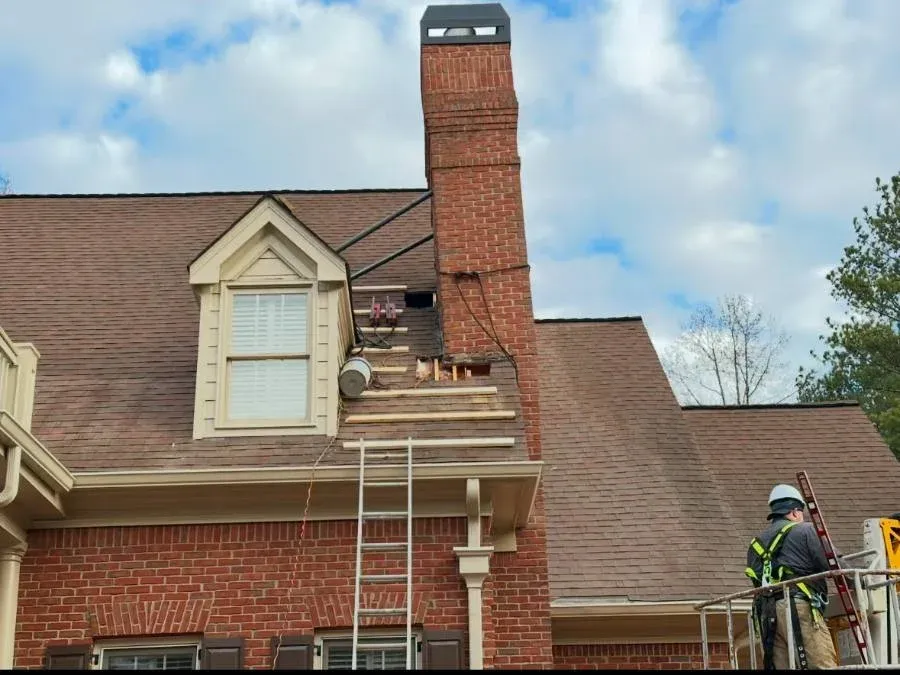
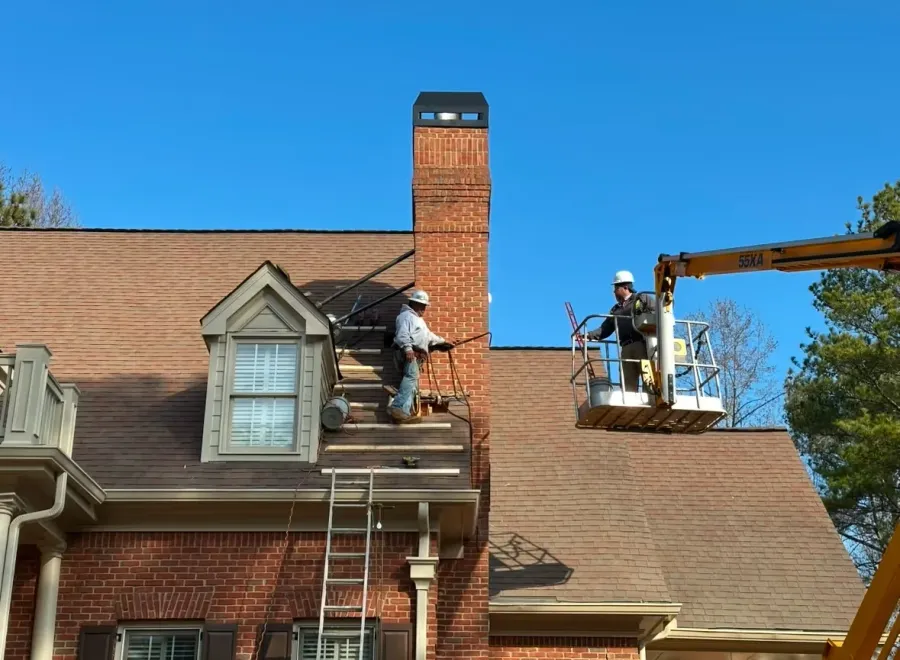
Leaning chimneys are the job our family is best known for, and Acworth houses show two kinds.
On a lot falling toward the lake or a creek, a downhill brick chimney puts heavy weight on one small footing. When the fill or wet clay under it gives, the chimney pulls away and the crack runs from the ground up to the soffit.
On many 1990s and 2000s houses the mason set the brick above the soffit on roof decking instead of a load-bearing wall, so the top tilts in while the base looks fine. We carry that weight with structural steel set on a load-bearing wall in the attic.
Near downtown, city guidelines ask owners to keep historic chimneys, and straightening keeps the original brick standing. Our leaning chimney repair page covers both kinds of lean.
Most of the rest of our work here comes from building on a slope.

Lake-side decks sink at the posts. We pier failed deck footings and replace rotted posts with wood or steel. A brick stoop on subdivision backfill sinks away from the front door. We lift it back on piers.

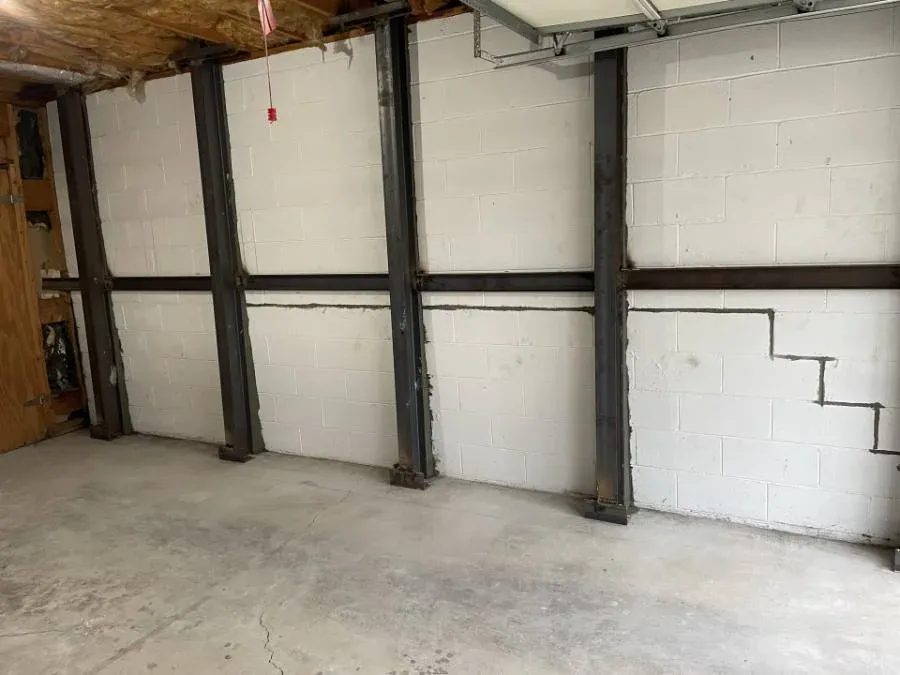
A block wall holding back the hill can crack and bow. Basement wall repair locks it in place with steel beams.

A retaining wall holding dirt gets locked where it stands. A freestanding one can often come all the way back, usually in one to two days.

Acworth's guidelines ask historic homeowners to keep pier foundations open. When the floor above sags, we level it from underneath.
Acworth sits in northwest Cobb County on the southeastern banks of Lake Acworth and Lake Allatoona, and water covers about 6 percent of the city. Fewer than one in twenty houses here were built before 1960, and the subdivisions that followed climb the hills between the lakes and the creek valleys.
The Collins Avenue Historic District, a local historic district since 1998, holds Victorian houses from about 1890 to 1910 and Craftsman bungalows from the 1920s. Park Street is the city's other local historic district, and downtown along Main Street and the railroad joined the National Register in 2006.
Brookstone's golf club was built in 1988 and homes there went up into the mid-2000s. In the 30102 ZIP code the 1980s were the busiest decade for building, so many of those basement walls and chimneys are around 40 years old now.
Take a typical two-story walk-out basement house where the downhill corner and the chimney beside it have settled. Steel push piers go under the footings at that corner and under the chimney, driven to load-bearing ground with no charge for depth. The corner comes up while push poles press the chimney back to the wall.
If the buried basement wall has cracked sideways, steel beams lock it in where it stands. Our masons repair the joints the movement opened, many jobs like this are done in one day, and you hardly ever need to leave the house while we work.
Hear from homeowners about the repair, the crew, and the finished work.
“The team that lifted our chimney was prompt, courteous and efficient. Other then the repair, you simply could not tell they were even there despite the fact they had to remove part of our deck to do the work.”
Honest answers before you make a decision.
Still have QuestionsTell us which corner is dropping or which way the chimney leans, and we'll come out, measure it and write up the repair at no cost. Call 770-422-2924, Monday through Saturday, 8 AM to 6 PM.
Book a free look at the low side
Schedule your free estimate with a quick phone call.
770-422-2924