

Veneer checked before piers get quoted
A stair-step crack in a 1990s brick front can be loose veneer or a dropped footing, and we tell you which.
Many of Alpharetta's 1980s and '90s basements sit on graded ground that has had decades to settle, and Anglin's foundation repair crews put those corners and chimneys back on steel.
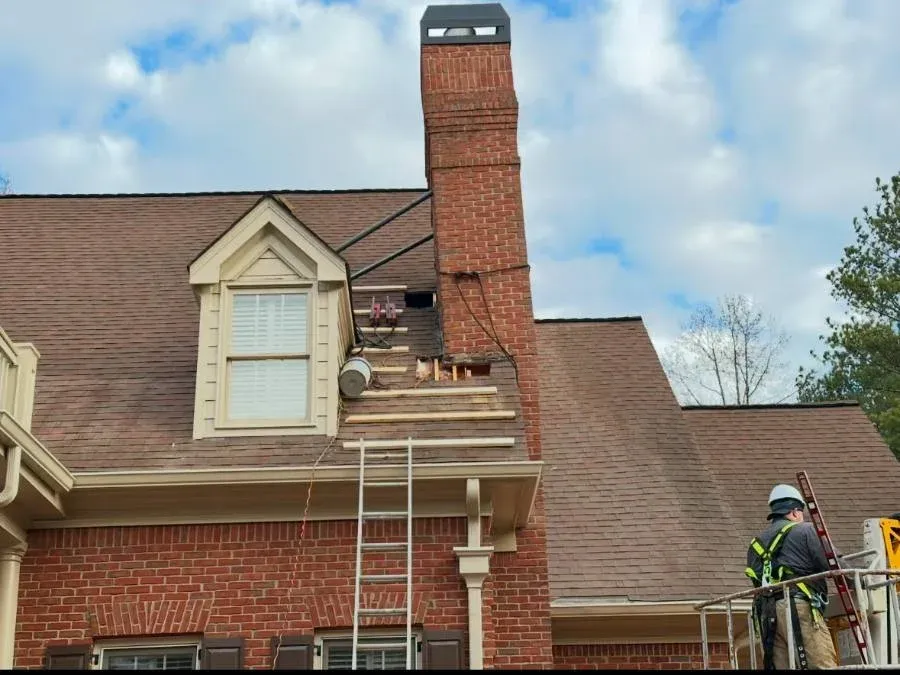
Anglin's does foundation repair in Alpharetta, GA on most of the city's houses: two-story 1980s and 1990s homes, many with basements on graded lots. We stabilize settling corners and leaning chimneys with steel push piers, and our own masons repair the brick. Your free estimate comes from someone who has installed piers, not a commissioned salesman.
Census counts put more than half of Alpharetta's homes in the 1980 to 1999 window, the age when settled fill, broken wall ties and sagging garage lintels start showing up together.
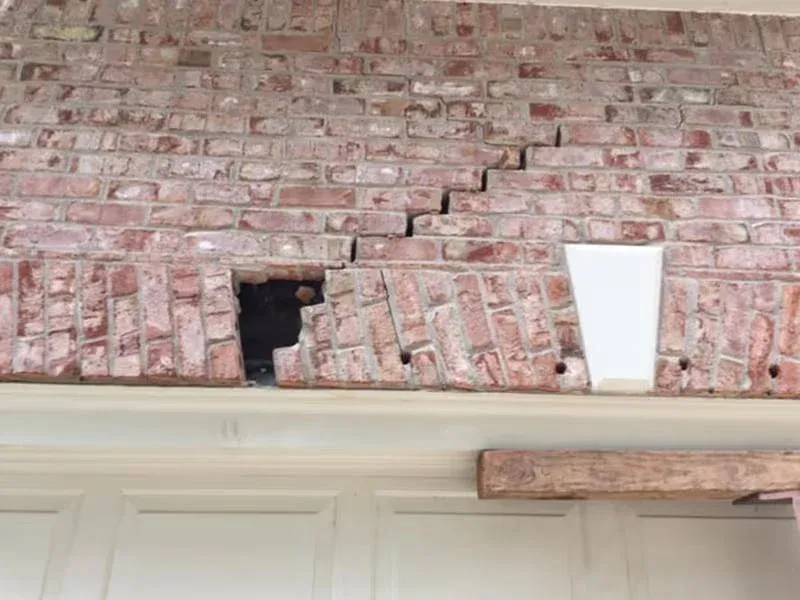
You back out of the garage and the crack over the door catches your eye again. It runs a little farther up the brick than it did last spring, and the front window over the porch has started to stick. Houses like yours went up here in the 1980s and 1990s on pads cut and filled out of rolling ground.
Forty years later, the dirt under one corner has given more than the dirt under the rest, and the brick above it shows that first. From the street it looks like nothing much. It is still worth having somebody read that crack before it steps across the front of the house.
Foundation trouble here usually arrives with cracked brick attached, so one company should handle both halves.
A stair-step crack in a 1990s brick front can be loose veneer or a dropped footing, and we tell you which.

A pier may pass through a lot of graded dirt before it bears, and that extra depth never costs you extra.

Certified welders fabricate them in-house for heavy loads like a two-story gable chimney. The people who lift your garage corner also match the brick afterward, with no subcontractors.

Our piers carry a lifetime warranty that transfers to the next owner if you sell.
The USDA soil survey maps much of central Alpharetta as "urban land," ground reworked so heavily that no native soil gets named, which is likely how the city's basement lots were graded: cut the high spots, fill the low ones. The native Appling and Hard Labor clays here are a low-shrink type, so water and loose fill do the work, not seasonal swelling.
Loose fill keeps compressing under a house for years, and rarely evenly. Corners carry the most weight, so settling usually starts there and pulls the brick toward the low spot.
Slopes of 10 to 25 percent send runoff at uphill basement walls, and low lots along Big Creek stay soaked after heavy storms.
The foundation repair page walks through each step of a pier installation.
On many two-story houses of this era the chimney climbs the outside of a brick gable. When its footing settles the chimney tips outward, leaving a crack from the ground toward the soffit and daylight between the brick and the siding. The cause is the soil under the chimney rather than the brickwork.
That one usually traces back to a mason who rested the upper brick on plywood and rafters rather than a load-bearing wall.
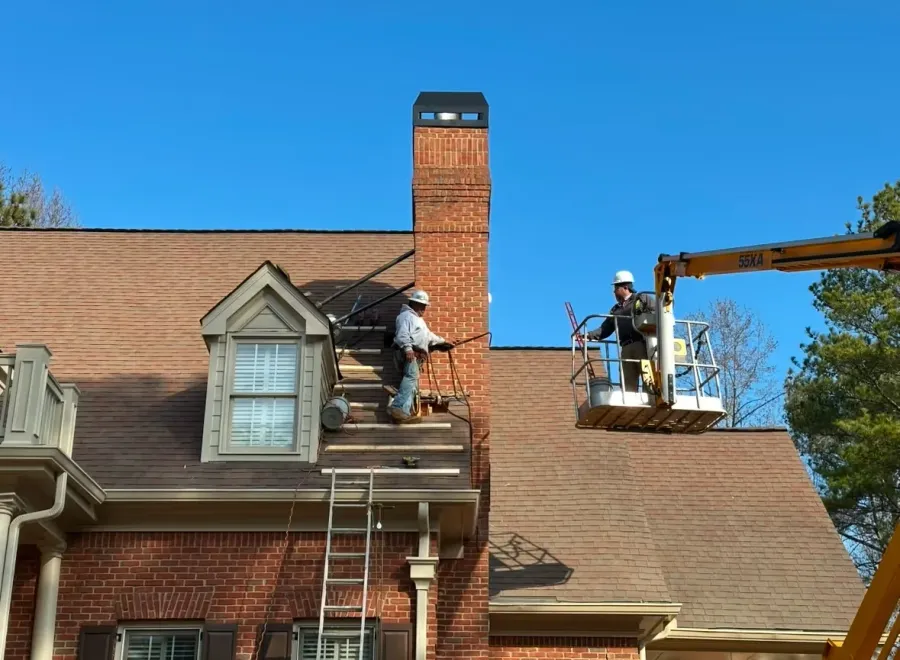
We drive steel push piers under the footing, then lift and push the chimney toward the house together, since piers alone rarely bring it back to plumb. Brick anchors replace the broken wall ties, and the same crew repairs the opened mortar with no teardown.
We don't do liners, caps or flue work, and any flashing after a roof opening belongs to your roofer. Read more about our leaning chimney repair process.
Houses from the same era as Windward and Berkshire Manor can need one of these alongside the foundation work.

Garage lintel repair fixes the brick crack that climbs from a door corner when the lintel above it sags.

Basement wall repair braces poured or block walls that wet backfill has pushed inward.

About one in nine Alpharetta homes is attached, and their poured stoops can settle away from the house until we pier them.

The few homes left from the 1850s to the 1910s can have floors that dip as the old supports under them give way.
Alpharetta grew in two big waves. The 1980s added about a fifth of today's homes and the 1990s about a third, mostly two-story basement houses on graded lots, while only a small slice predates 1980.
Sloped lake lots often mean walk-out basements and retaining walls.
Downtown is older still, with a handful of houses from 1856 to 1912, at least one still keeping its original mantels. The city's Historic Preservation Commission keeps an inventory of properties with potential for historic designation.
The National Weather Service warned in May 2026 that Big Creek would put water in low-lying backyards, at levels not seen since early 2020. Ground that stays soaked that long softens under footings, and the low corner of a basement house is usually where settling shows first.
A chimney job on a house built like Alpharetta's usually starts the same way. The chimney has pulled a few inches off the gable, with a gap you can see from the yard. We dig at the footing, bracket it, and drive steel push piers down to load-bearing strata.
Hydraulic pressure lifts the footing while push poles bring the top back in. Brick anchors tie the chimney back to the house, and fresh mortar goes into the opened joints, usually in one day.
Hear from homeowners about the repair, the crew, and the finished work.
“We had Anglin's repair some masonry cracks mainly in the front of the house. The two main areas were two large windows and over our garage. Communication with Anglin's was fantastic.”
Honest answers before you make a decision.
Still have QuestionsOne trip covers the basement corners, the garage opening and the chimney footing, and you leave with a written proposal. Our office picks up Monday through Saturday at 770-422-2924, and a live answering service takes calls after hours.
Get a free two-page proposal
Schedule your free estimate with a quick phone call.
770-422-2924