
Rock at 18 inches, or deep clay
Piers keep going until they meet bearing ground, and depth is never billed by the foot.
East Cobb's 1970s and 1980s basement houses were built into eroded clay hillsides, and when their walls bow or their back corners and chimneys sink and tilt, Anglin's repairs them.
Anglin's does foundation repair in East Cobb from our Marietta office, a family business since 1930. Census figures put the median home in the 30068 ZIP at 1981 and in 30062 at 1985, with more than half the houses in both built between 1970 and 1989, so the work here centers on basements and steep yards.
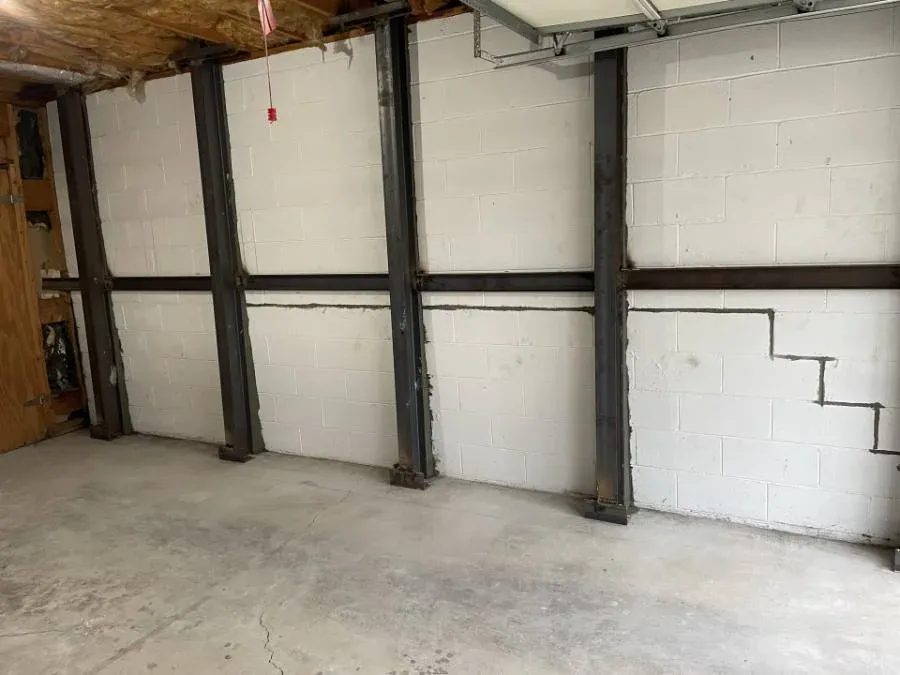
The trouble usually starts below grade: a block basement wall bowing in, a back corner dropping toward the low side of the lot, or a brick chimney pulling off the siding. Our crew drives steel push piers, braces walls with steel beams and finishes the brick. Estimates are free at 770-422-2924.
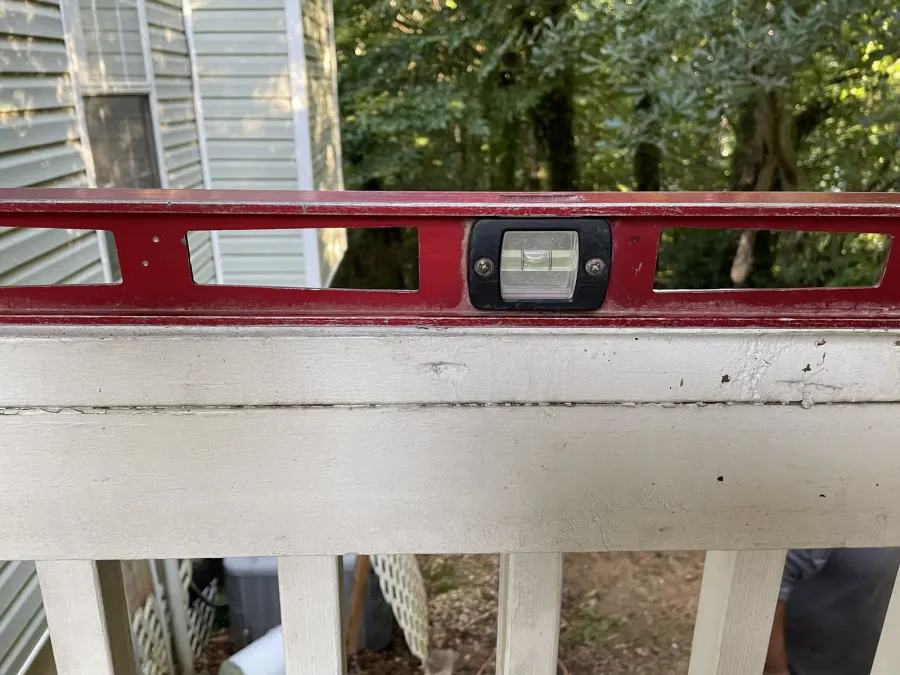
From the yard below, the posts under your deck look longer than they used to. One has settled into the ground far enough that the beam above it sags, and the boards creak when somebody walks out there.
That is what a daylight basement lot does. The downhill side falls away toward a creek branch, and the posts out there stand on whatever got pushed back around the foundation. While you are back there, check the block wall on the uphill side of the basement, because on this kind of lot the two travel together. Both get fixed with steel under them rather than a teardown.
Hillside lots with changing ground ask a lot of a contractor.
Piers keep going until they meet bearing ground, and depth is never billed by the foot.

Certified welders build our brackets in our own shop. The crew that braces the basement or straightens the chimney also matches the brick and mortar outside.

We don't do waterproofing or drainage, and we'll tell you at the estimate if water is a bigger problem than the wall. Marietta borders East Cobb on the west, and a live person answers our phone even after hours.

Our piers carry a lifetime warranty, and if the house sells it passes to the new owner under the same two-page contract.
USDA maps along Johnson Ferry, Lower Roswell and Sandy Plains show Madison and Pacolet soils on 10% to 25% slopes, much of it eroded or severely eroded. The subsoil is 40% to 50% clay, rated low for shrink and swell but soft once it stays wet, and our foundation repair starts there.
Weathered rock maps about 18 inches down near Indian Hills, while nearby uplands run very deep, so pier depth changes lot to lot.
A house graded into a slope holds soil against its uphill basement wall. After 40-plus years of rain, that block can crack horizontally and bow inward.
Sope Creek falls nearly 300 feet from Marietta through East Cobb to the Chattahoochee, and in September 2009 it hit its highest recorded flow, about four feet above the bridge in East Cobb Park. On lots dropping toward it, settling often shows at the back corner or deck posts.
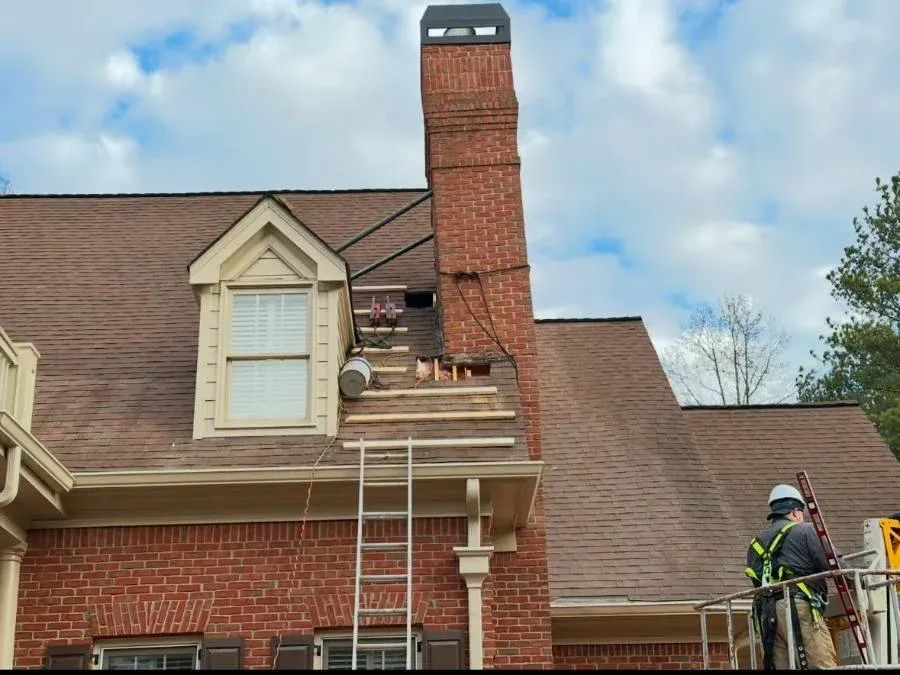
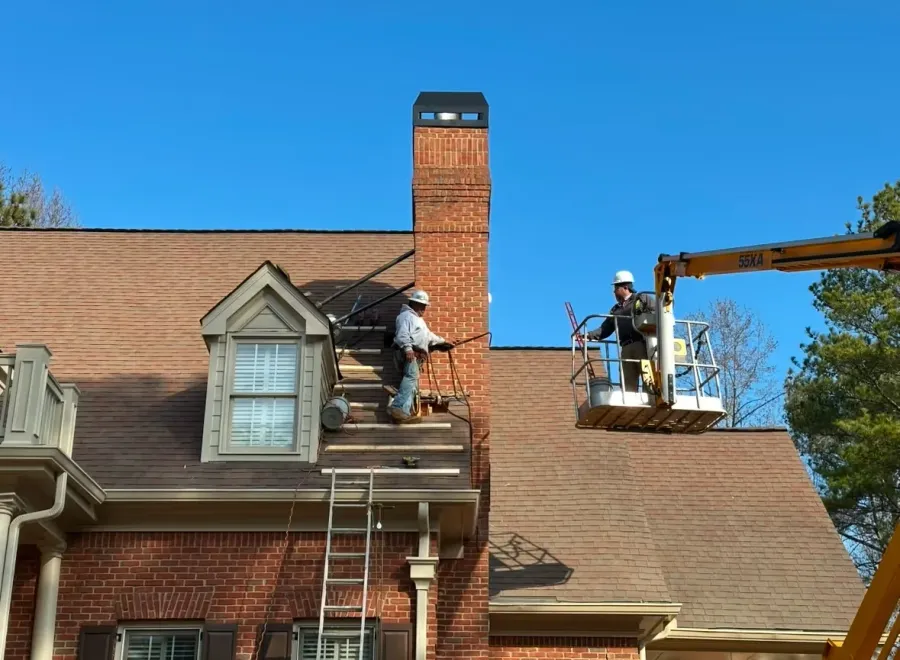
A chimney that leans or separates can usually be saved, even when somebody has told you it needs rebuilding.
The footing can rest on backfill pushed in around the basement, and loose fill lets the stack drop and tilt off the wall. That one needs piers.
The upper brick was usually rested on roof decking. A prefabricated fireplace with a brick chase can do both, tipping in at the top while bowing out toward the street.
Where the footing settled, we set steel piers and lift while push poles staked in the yard bring the chimney in, because piers alone can leave it out of plumb. Anchors through the mortar tie it back to the wall, and our masons match the joints.
A roofing contractor takes care of the flashing, which we explain before work starts. Read how leaning chimney repair handles leans above and below the roofline.
Sloped lots put strain on more than the house, and these are the other repairs we see on them.

A wall leaning over a lower yard can be stabilized with piers or tiebacks, and we repair existing retaining walls but don't build new ones.

Decks stand high on the downhill side, and we stabilize sinking deck posts that have dropped.

Cracks climbing from a garage door corner on a 1980s house usually point to a sagging lintel overhead. Brick pulling away on the low side of a graded lot often means broken wall ties, which we pin back with matched mortar.

Brick steps built on loose fill beside the basement drop away from the door, and we lift them on piers.
East Cobb isn't a city. It's unincorporated Cobb County between the Cherokee County line and I-285, bounded by Bells Ferry Road, I-575 and Marietta city limits on the west and by Willeo Creek and the Chattahoochee on the east.
Indian Hills opened in the early 1970s on farmland between Lower Roswell Road and what was then Upper Roswell Road, and it's considered the development that turned the old Mt. Bethel community into East Cobb.
Census data shows East Cobb's busiest building years were the 1970s and 1980s, as subdivisions spread north toward Sweat Mountain, the area's high point. Near the river, the Chattahoochee cuts steep, rocky bluffs along the Brevard Fault Zone.
The older the house, the more years its uphill basement wall has spent holding back wet clay.
On a typical 1970s or 1980s basement house, with no one address in mind, the job goes like this. Steel beams go against the bowed block to hold back the soil and stop the inward movement.
If a corner has settled too, push piers go under that footing. Any cracked brick outside is repaired by the same crew.
Hear from homeowners about the repair, the crew, and the finished work.
“Anglin’s did an outstanding job on installing permanent support beams for bowing concrete walls in my basement. I had estimates from other companies, but Anglin’s had the best price and best solution.”
Honest answers before you make a decision.
Still have QuestionsRing 770-422-2924 any day but Sunday, or leave word with the person who answers after hours. One call sets up a free look at the wall, the corner or the chimney.
Set up your free structural estimate
Schedule your free estimate with a quick phone call.
770-422-2924