Foundation and Leaning Chimney Repair in Marietta, GA

From brick houses near the Square to 1980s basements cut into hillsides, Marietta foundations sink where clay stays wet or slopes lost their topsoil, and Anglin's, a Marietta family business since 1930, sets them back on steel piers.

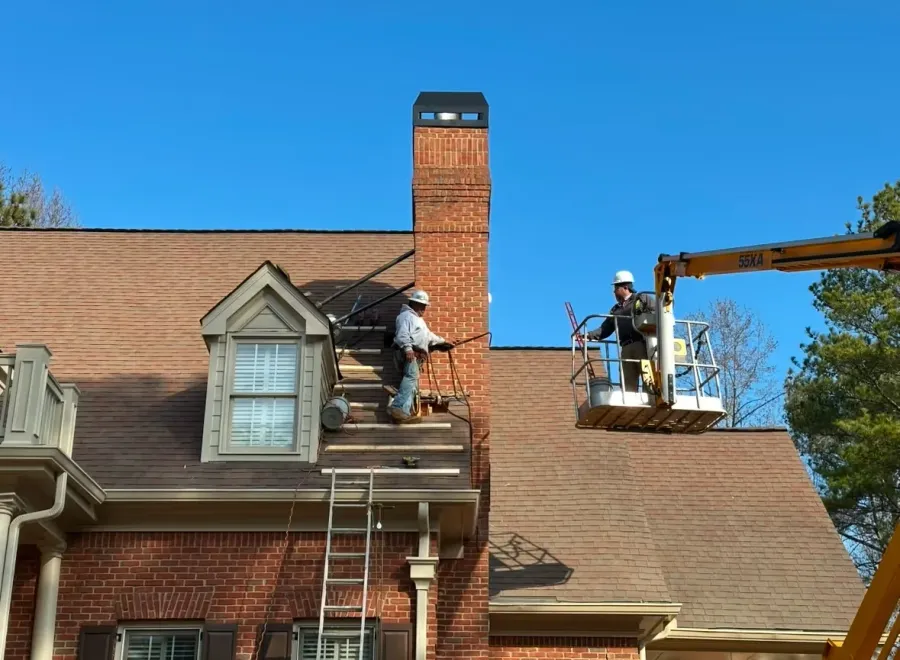
Leaning brick chimney before repair
Two centuries of houses

Foundation repair in Marietta for historic brick, hillside basements and chimneys

Anglin's does foundation repair in Marietta from the office our family has run here since 1930. We drive steel push piers under settled footings, bring leaning chimneys back to plumb, and the same crew restores the brick and mortar afterward. Estimates are free at 770-422-2924, and most jobs wrap up in one day.

Marietta's houses span nearly two centuries, from 1830s homes in the historic districts to a citywide median build year of 1987, and the problems differ by era.

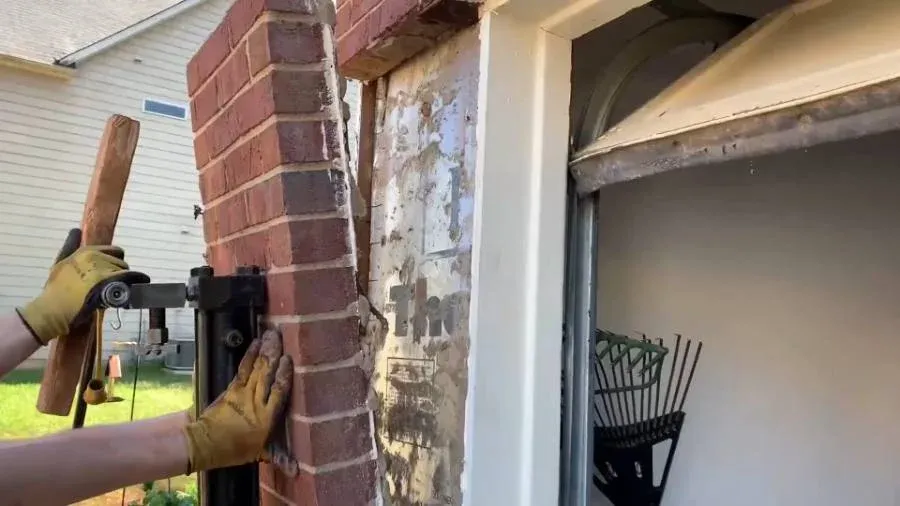
Brick wall before repair
Daylight beside the chimney

Daylight between a Marietta chimney and the wall

From the yard you can see a line of daylight between the chimney brick and the siding. It was not there a few summers back. Up close, the mortar joints near the top have opened and a crack runs down toward the ground.

Around here that happens two ways, from a footing laid generations ago near the Square or from backfill beside a 1980s basement. Either way it moves a little more each wet season, and we measure the lean before quoting anything, because how far it has gone changes what the repair takes.

Four generations, same town

A Marietta family crew for a Marietta house

Four generations of our family have worked out of this town, and these are the habits that come with that.

Family-owned and straightforward

Olin L. Anglin founded the company in 1930, Skip and Scott run it today, and Alec and Brett represent the fourth generation. The contract runs two pages, the price on the contract is the price at the end, and a live person answers after hours.

Piers and brick, one crew

A Whitlock Avenue or Church Street house has to look original afterward, so the people who set the piers also match the mortar.

No charge for pier depth

Pier depth changes from lot to lot, from creek bottoms to the Square, and we never bill extra for it.

Honest read on old veneer

Cracked brick on an older house often traces to rusted wall ties, and when it does we say so and skip the piers.

From the Square to the creeks

What moves Marietta foundations, Square to creek bottoms

The USDA soil survey changes across town. Around the Square the ground maps as urban land mixed with Cecil soil, cut and filled as Marietta grew, while Whitlock Avenue and Church and Cherokee streets turn to Pacolet and Madison soils on 10% to 25% slopes. See foundation repair for the pier work.

Clay beside a clogged downspout

That subsoil is roughly half clay, rated low for shrink and swell. The usual trouble is water: clay beside a clogged downspout stays saturated, softens and lets the heaviest corner of the house sink.

Graded hillside lots and backfill

A porch, stoop or chimney set on backfill that was never compacted properly settles apart from the house.

Soft ground along three creeks

Sope Creek starts inside Marietta west of I-75, Rottenwood Creek runs through town, and the Northwest Marietta district reaches Noses Creek. Creek-bottom soil in south Marietta is mapped as frequently flooded, which gives a footing weak bearing.

What people say when they call
  • "Chimney leaning inward, crack in brick veneer"
  • "front stoop that is starting to sink, crack"
  • "cinder block around the home is cracking"
  • "slope to it and uneven floors"
Our bread and butter

Why Marietta chimneys tip, antebellum to 1980s

Our owners call leaning chimneys the bread and butter of the business, and in Marietta the direction of the lean says a lot about the house.

The whole stack tips from the ground up

On an older house in the historic districts the chimney can be solid masonry, and a settled footing takes the whole stack with it.

It pulls off the siding on a 1980s house

That footing sits on backfill beside the basement, and the chimney separates as the soil gives.

The lean starts above the roofline

The mason rested the upper brick on roof decking rather than a bearing wall.

Piers, push poles and repointed joints

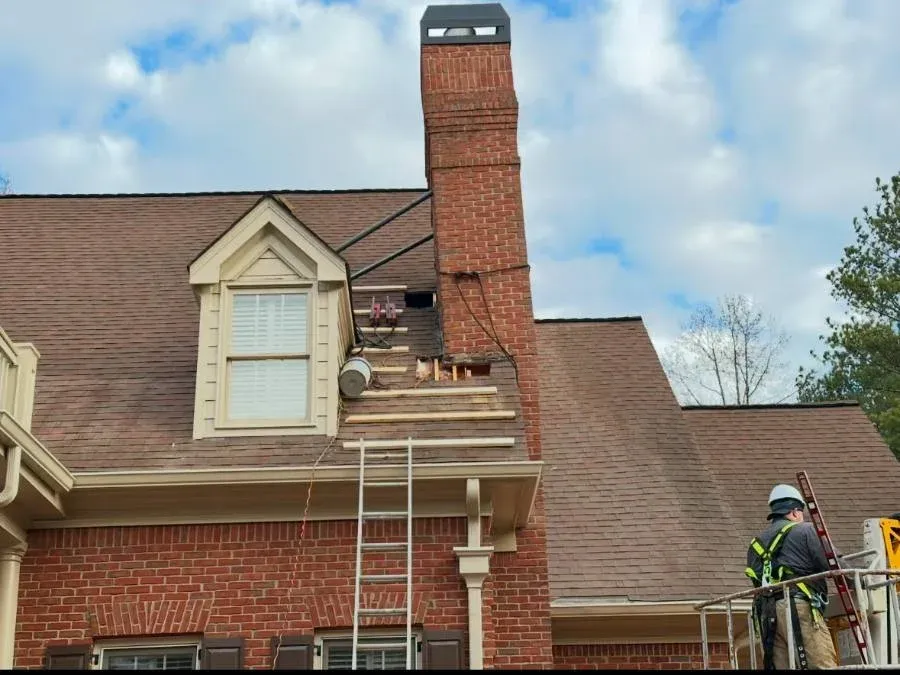
For a settled footing we set steel piers down to load-bearing ground, and during the lift push poles braced in the yard press the chimney toward the house, since piers alone won't bring it back to plumb.

Brick anchors hold it to the wall and our masons repoint the joints. We say up front that a roofer handles the flashing. Here's how our leaning chimney repair process runs.

Chimney after repair
More ways we can help

From 30060 crawl spaces to hillside garages

The rest of our work in town tracks the age of the house.

Rolling floors in 30060

About a fifth of homes in this ZIP predate 1960, some on crawl spaces where we level sagging floors from below.

Brick steps and garage lintels

Steps are named in the preservation ordinance, so we lift sinking steps and stoops on piers and match the brick. A crack stepping up from a garage door corner usually means the steel lintel overhead has sagged.

Bowing block in 1980s basements

Walls cut into Marietta's slopes hold soil on one side, and we brace the ones pushing inward with steel beams.

Church and Cherokee retaining walls

Lots mapped at 10% to 25% slope lean on retaining walls, and we stabilize existing ones with piers or tiebacks.

Kennesaw Avenue to Whitlock

Marietta's historic cores and hillside subdivisions

Marietta is the Cobb County seat, and its oldest streets fan out from the Square onto real grade.

Two centuries of housing

About 10% of the city's houses predate 1960, while roughly four in ten went up in the 1980s and 1990s in subdivisions graded into the hills toward Kennesaw Mountain. Those newer houses are old enough for fill under stoops and basement walls to show it.

Five National Register districts

The Northwest Marietta Historic District holds buildings from about 1838 to 1898 and runs out Kennesaw Avenue to Noses Creek. Whitlock Avenue's district spans Greek Revival houses to 1930s Craftsman bungalows on slopes mapped as eroded.

  • Also on the National Register: Church Street-Cherokee Street, Washington Avenue and Atlanta-Frasier Street.
1950s and 1960s houses in 30060

Central and south Marietta, ZIP code 30060, holds the oldest housing of any Marietta ZIP, with a median build year of 1976. A third of its houses went up in the 1950s and 1960s, and about a fifth predate 1960. Footings that old have seen 50-plus wet winters and clogged gutters.

Preservation, creek and flood pages
Four inches back in a day

A decade of chimney lean corrected in one day

This is one of our own Marietta projects, completed in May 2026. The chimney had tilted away from the house for about 10 years and sat roughly four inches out, with a visible gap at the wall, because its footing had settled.

  • Two steel piers: set beneath the footing and driven past the failed soil to load-bearing strata.
  • A tree at the footing: removed at no charge so it couldn't keep working against the repair.
  • The lift: controlled hydraulic pressure brought the chimney back evenly, about four inches.
  • The mortar: joints that loosened as it moved were repaired by our masons once the structure was still.

Structure and masonry were both finished the same day.

Chimney after repair
Customer Reviews

The work matters.
So does your word.

Hear from homeowners about the repair, the crew, and the finished work.

★★★★★
“It became clear to us that Anglin's was the ONLY company that really understood the root cause of the issues and how to provide a permanent fix... After they stabilized everything, they did all the masonry repairs (the cosmetics) and it all looks beautiful.”
Beth L.
Settling bay window and porch set on piers, masonry restored
What people ask around town

Before you call: Marietta questions about settling and leaning

Honest answers before you make a decision.

Still have Questions

It depends mainly on the number of piers, the weight each one lifts and how much digging access takes, and the estimate costs nothing. A chimney or center garage column runs more per pier because one pier holds so much load. Depth is never added to the bill.

The repair itself is usually a one-day job, like the Marietta chimney we finished in May 2026. Scheduling usually runs one to four weeks after you approve the estimate.

Usually not. That same Marietta chimney had leaned about 10 years and came back roughly four inches on two steel piers. Every chimney is different, so we measure yours before giving you a number.

Slope and fill do most of the damage. Around Whitlock Avenue and Church and Cherokee streets, the soil maps show 10% to 25% slopes, some labeled eroded, and many 1980s and 1990s lots were graded into the hill. A stoop, porch or chimney on backfill that was never compacted settles apart from the house, especially where water runs toward it.

Not if it's ordinary repair that keeps the steps' design, material and outer appearance. Rebuilding them in a different style or brick is a visible change that goes to the Historic Preservation Commission.

We only install steel push piers, never helical piers, on existing houses. A helical pier is screwed in and suits lighter loads, while a push pier is driven under the weight of the house to load-bearing ground.

Tell us what's cracking

Call the Marietta family fixing houses since 1930

Tell us what's cracking or leaning, and we'll set up a free look at the house.

Schedule your free chimney and foundation check

Give us a call

Schedule your free estimate with a quick phone call.

770-422-2924
Call NowGet Quote