
How Georgia Red Clay Affects Your Foundation
Metro Atlanta's red clay swells when wet and shrinks when dry, moving the footings under your house. Here's why that cracks foundations.
Posted August 4, 2026
Topics: Foundation Repair
If you own a home in Metro Atlanta, the ground it sits on has a lot to say about whether your foundation stays put. That ground is mostly red clay, and clay is one of the hardest soils to build on. Here is why, and what it means for your house.
Why red clay is hard on a foundation
Georgia's red clay is what is called an expansive soil. It soaks up water and swells, sometimes with real force, and then dries out and shrinks back down. It does this over and over, every wet season and every dry spell. The footings your house rests on ride on top of that soil, so every time the clay swells and shrinks, it lifts and drops the foundation with it.
The problem is that it never happens evenly. One side of the house gets more sun, one side sheds more water, one corner has a big tree pulling moisture out of the ground. So one part of the foundation moves more than another, and that uneven movement is what cracks brick, sticks doors, and slopes floors.
Where it shows up
- Stair-step cracks in exterior brick, often near the corners of the house
- Cracks inside at the corners of doors and windows
- Doors and windows that stick in some seasons and not others
- Floors that slope or feel uneven
- Gaps opening between the walls and the ceiling or trim
The seasonal part is a giveaway. If a door sticks in the wet months and frees up when things dry out, that is the clay swelling and shrinking under your house.
What makes it worse, and what helps
Anything that keeps the soil around your foundation unevenly wet makes clay movement worse: downspouts dumping next to the house, a yard graded toward the foundation, or poor drainage on one side. Keeping water moving away from the house evenly helps. But once the clay has already settled the foundation unevenly, drainage alone will not lift it back.
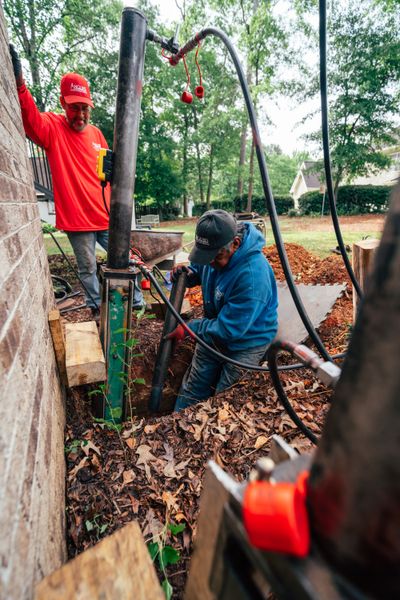
For that, we stabilize the foundation with steel piers driven down past the active clay to solid ground that does not swell and shrink with the weather. That takes the house off the moving soil and sets it on something stable. See our foundation repair page for more on how that works.
More From The Blog See all
-

Foundation Repair
Should You Buy a House With Foundation Problems?
Foundation issues on a home you're buying are common, fixable, and often a reason to negotiate rather than walk. Here's how to tell what's what.
-
Foundation Repair
Concrete Leveling vs. Replacement: What Homeowners Should Know
Sunken concrete can often be lifted instead of replaced. Here's what the different methods actually are, and which one Anglin's performs.
-
Foundation Repair
Warning Signs Your Foundation Is Failing
Foundation problems show up as small things that are easy to explain away. Here's what to look for, and when a pattern means it's time to act.