
What Foundation Repair Costs in Georgia
Most quotes are a vague range. Here is what foundation repair really costs in Metro Atlanta, what moves the price, and the minimum we publish.
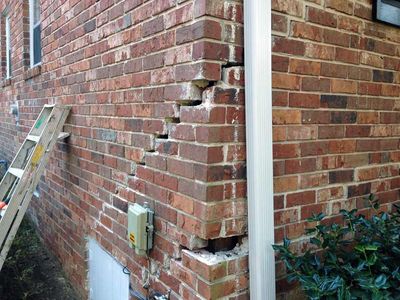
Posted August 25, 2026
Topics: Foundation Repair
If you have been searching for what foundation repair costs, you have probably noticed something frustrating. One page says $500 to $10,000. The next says $4,000 to $13,500. Another says $1,200 to $3,000. They cannot all be right, and none of them are talking about your house.
We are going to do this differently. Below is what we can tell you honestly before we have seen your property, what actually sets the price, and why we will not pretend an average exists.
What we can tell you before we ever see your house
Three things, and they are the same three for everybody who calls.
Our minimum project cost is $3,000. That is the floor. If your repair is smaller than that, we will still come look, and we will tell you honestly that it is smaller than that, but $3,000 is where our projects start.
The inspection is free. We come out, look at the structure, and tell you what we find. There is no charge for that and no obligation attached to it.
The number you approve is the number you pay. That is our Price Protection Guarantee, and it is not marketing language. If we open up the work and find something nobody could have seen from the surface, that is our problem to absorb, not a change order we hand you halfway through.
Why nobody can give you a real average
Foundation repair is not a product with a price tag. It is a measurement problem.
When we quote a job, we are answering questions like: how many piers does this house need, and where. How deep does each one have to be driven before it hits ground that will actually carry the load. Can our equipment reach the work area, or is everything going in by hand through a side yard. How much of the brick, mortar and interior finish has to be restored once the structure is back where it belongs.
Change any one of those and the price changes with it. That is why a national average is close to meaningless here. A house needing 4 piers along one wall in an accessible back yard, and a house needing 14 piers with a deep drive and no equipment access, are both "foundation repair," and the two numbers are nothing alike.
The ranges you see online are not lies. They are just averages of thousands of houses that are not yours.
What actually moves the price
How far it moved, and how much of the house came with it. A corner that has dropped a small amount is a different job from one that has taken the brick, the floor system and three door frames down with it. Catching movement early is the single biggest thing a homeowner controls about the final bill.
How deep the piers have to go. Our steel piers are driven down until they reach strata that will actually bear the load. In some yards that is not far. In others it is considerably farther, and every additional foot is material and labor.
Access. A back yard we can get equipment into costs less to work in than a tight side yard where everything moves by hand. This is unglamorous and it is real.
What has to be restored afterward. This is where we differ from most of the trade. Stabilizing the structure is the engineering half. Putting the brick and mortar back so the repair is not the last thing you look at every time you pull into the driveway is the other half, and we do that in-house rather than handing you a list of masons to call.
Why Georgia is its own problem
Metro Atlanta sits on Piedmont red clay, and clay is the reason so much of this work exists here.
Swelling clay soils take on water and expand, then dry out and contract, over and over with the seasons. The U.S. Geological Survey describes the mechanism plainly: swelling clay "expands or contracts in response to changes in environmental factors," and hydration and dehydration "can vary the thickness of a single clay particle by almost 100 percent." Their conclusion about what that does to buildings is equally plain: houses "built on soils containing swelling clays may be subject to structural damage caused by seasonal swelling of the clay portion of the soil."[1]
That is the whole story of a Georgia foundation in two sentences. The ground under your footings is not stable. It moves every year, it does not move evenly, and eventually the house tells you about it through a crack, a sticking door, or a chimney pulling away from the wall.
It also explains why repairs here have to reach past the clay. Anything that stops in the layer that is doing the moving has not solved the problem, it has joined it. If you want the longer version of this, we wrote about how Georgia clay affects your foundation separately.
Is foundation repair worth it?
Almost always, and the reason is simple. Foundation movement does not reverse itself and it does not plateau out of courtesy.
Every season the movement continues, it takes a little more of the house with it. The crack that was hairline last spring is wider now. The door that stuck in August does not close at all. The brick that was separating at one corner has opened along the whole wall. None of that repairs itself, and all of it gets added to the eventual invoice.
The cheapest version of your repair is the one you do first. That is not a sales line, it is just the arithmetic of a problem that compounds.
There is also the resale side. A structural problem you know about and fixed, with documentation and a transferable warranty, is a conversation at closing. A structural problem discovered by the buyer's inspector is a renegotiation, and rarely in your favor.
Will homeowners insurance pay for it?
Usually not, and it is better to know that now than to budget around a reimbursement that is not coming.
Standard homeowners policies generally exclude earth movement, and settlement from expanding and contracting soil sits squarely in that category. State insurance regulators list it among the standard exclusions: the California Department of Insurance's consumer guide names "earth movement" outright among the perils generally not covered by a homeowners policy.[2]
Two things worth doing anyway. Read your own policy's exclusions section rather than trusting a general rule, because policies differ. And if you think a plumbing leak under the slab is what saturated the soil and started the movement, call your carrier and ask specifically about that, because water damage from a sudden failure is treated differently from soil that simply did what Georgia soil does.
If insurance is out and the number is real, financing is usually the practical answer, and we can walk you through what is available.
How to compare two quotes without getting burned
You are likely to get more than one number. A few things to hold them up against.
Ask what the number covers if the job turns out to be worse than it looked. This is the single most useful question you can ask a foundation contractor, and the answers vary enormously. Ours is the Price Protection Guarantee. Get somebody else's answer in writing.
Ask whether the price includes putting the masonry back. A quote that stabilizes the structure and leaves you with exposed, unrestored brick is not comparable to one that finishes the job, even though both say "foundation repair" at the top.
Ask what the warranty covers and whether it transfers. A warranty that dies when you sell the house is worth considerably less than one that goes to the next owner.
Ask who is actually doing the work. Crews, subcontractors and salespeople are three different things.
We wrote a fuller list of questions to ask a foundation repair company if you want to walk into the conversation prepared.
What happens when you call us
We come out and look. We tell you what we find, in plain language, including telling you if we think it can wait. Then you get a real number, not a range, and that number does not move.
If you are seeing cracks, sticking doors, sloping floors or a chimney separating from the wall, that is worth a look. Call us at 770-422-2924, or request a free inspection and we will come to you.
Sources
- U.S. Geological Survey, "Environmental Characteristics of Clays and Clay Mineral Deposits" — pubs.usgs.gov/info/clays
- California Department of Insurance, "Residential Insurance: Homeowners and Renters" — insurance.ca.gov
More From The Blog See all
-

Foundation Repair
Should You Buy a House With Foundation Problems?
Foundation issues on a home you're buying are common, fixable, and often a reason to negotiate rather than walk. Here's how to tell what's what.
-
Foundation Repair
Concrete Leveling vs. Replacement: What Homeowners Should Know
Sunken concrete can often be lifted instead of replaced. Here's what the different methods actually are, and which one Anglin's performs.
-
Foundation Repair
Warning Signs Your Foundation Is Failing
Foundation problems show up as small things that are easy to explain away. Here's what to look for, and when a pattern means it's time to act.