
Why Are My Basement Walls Bowing?
A basement wall bowing inward is losing its fight with the soil pressing against it. Here's what's causing it and how we brace it straight with steel.
Posted August 4, 2026
Topics: Basement Wall Repair
A basement wall is supposed to be straight and flat. When it starts to bow inward, lean, or crack across the middle, it is under more pressure than it was built to handle, and that is not a problem that fixes itself. The good news is that it is fixable, and caught early it does not have to mean tearing the wall out.
What is pushing on your wall
The soil packed against the outside of your basement wall is heavier than it looks, and it gets heavier when it is wet. After a good Georgia rain, that saturated clay presses against the wall with what is called hydrostatic pressure. A poured or block wall can take a lot of that pressure, but not forever. Over time it starts to give in the middle, where the push is strongest, and bows inward.
Warning signs
- A wall that bows or bulges inward, usually worst around the middle
- A horizontal crack running across the wall, often about halfway up
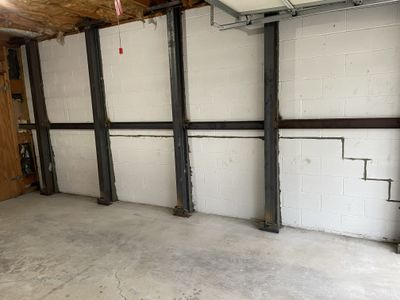
- Stair-step cracks in a block wall, following the mortar joints
- A wall that leans in at the top, or slides in at the bottom
- Cracks that let in water, or that keep widening over time
A horizontal crack across the middle of a basement wall is the one to pay attention to. That is the classic sign the wall is losing its fight with the soil.
Why it happens here
Georgia's red clay is the main culprit. It soaks up water and swells, and expansive clay pressing against a foundation wall is one of the hardest loads a wall can face. Poor drainage makes it worse: gutters that dump next to the foundation, a yard that slopes toward the house, or no working drainage behind the wall all keep that soil wet and heavy. Add years of settling, and the pressure wins.
How we fix it
For a bowing basement wall, we reinforce it with steel. We set steel H-beams against the wall, anchored top and bottom, to brace it against the soil pressure and hold it straight. In many cases, over time, the beams let us bring the wall back toward its original position rather than just stopping it where it is. It is a permanent structural fix that deals with the actual load on the wall, not a coat of paint over the crack.
Worth being clear on: for basement walls we brace with steel beams. The tie-back and wall-anchor systems you may have read about are what we use on retaining walls out in the yard, which is a different job.
If your basement wall is bowing or cracking, have it looked at before it moves any further. You can read more on our basement wall repair page.