
Why Is My Brick Pulling Away From the House?
Brick separating from your house usually means the wall ties failed or the foundation under it settled. Here's how to tell which, and how we fix it.
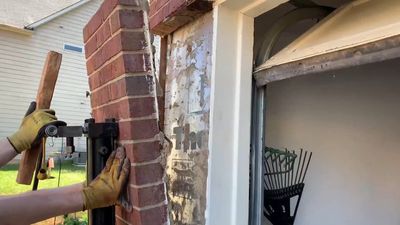
Posted August 4, 2026
Topics: Brick Wall Repair / Brick Gable Repair / Foundation Repair
When you spot a gap opening up between your brick and the rest of your house, at the corner of a window, along a door frame, or where the wall meets the soffit, it is unsettling. The good news is that this is a problem we see all the time, and in almost every case we can fix it without tearing the wall down. The part worth understanding first is that it does not always happen for the same reason.
Most people in this spot start by looking for a mason, and that instinct is not wrong. A cracked or separating brick wall is a masonry problem on the surface. What surprises people is finding out, after someone actually looks at it, that the brick is only telling on something happening underneath it.
The Brick Is a Skin
Most homes in the Atlanta area are built with a brick veneer. That means the brick is a single layer hung on the outside of the house for looks and weather protection. It is not holding the house up. The real structure is behind it, and the brick simply rides along on the same foundation.
That detail matters, because it explains what you are seeing. The veneer is held to the house by metal wall ties buried in the mortar joints, and it rests on the same foundation the rest of the house does. So when brick starts separating, one of two things has usually happened: the ties let go, or the ground moved. Sometimes both.
When the wall ties have failed
The ties are thin metal straps set into the mortar every few courses, tying the brick back to the structure behind it. You never see them, and they do not last forever. Water getting into a wall rusts them through, and on plenty of older homes there were too few of them to begin with, or they were spaced too far apart.
Once enough ties give up, the veneer is standing on its own. Brick is heavy and it is not built to be self-supporting, so it starts to lean out, bulge in the middle of a span, or open a gap at the top. The house behind it has not moved at all. The skin has simply stopped holding on.
This is the version people are most often surprised by, because nothing is wrong with the foundation and nothing needs to be done to it.
When the gable is the problem
The brick above the roof line at a gable end is the most exposed veneer on the house. It is tall, it is heavy, there is less structure behind it to tie into, and it takes the most weather. Gables are one of the first places we see brick begin to separate and tip outward, and it can happen while every wall below it is still tight.
When the foundation has settled
The other cause is the ground. When the footing under part of the house sinks, the brick sitting on it goes down too, and because brick does not bend it cracks and separates instead. Metro Atlanta sits on red clay, which swells when it is wet and shrinks when it is dry, working against a footing season after season. Add poor drainage dumping water against one corner, or fill dirt that was never compacted before the house went up, and you get the uneven settling that pulls brick apart.
This is more common than most homeowners realize. Every year, expansive soils cause more property damage nationally than tornadoes, floods, hurricanes, and earthquakes combined.[1]
Here the brick is the symptom and the foundation is the problem, which is a different repair entirely.
Cosmetic or Structural?
Both causes can leave a diagonal crack climbing through the mortar joints, and from the driveway they can look identical. Professional inspection standards point at the same detail we look for on a job: cracks caused by uneven settlement show up most often at corners and next to openings like windows and doors, running a rough diagonal along the mortar joints, and in worse cases carrying on into the floor slab or the drywall inside.[2]
None of that tells you for certain which cause you have on your own wall, but it is the pattern worth checking for before assuming a crack is nothing: is it near a corner or an opening, does it run diagonally rather than straight up and down, and has it shown up inside the house too. If any of that is true, it is worth having looked at rather than just repointed.
Warning signs to look for
- Stair-step cracks that climb through the mortar joints, following the brick pattern
- A gap opening at the corner of a window or door, often wider at the top than at the bottom
- Brick separating from the trim, the garage frame, or the soffit under the roof
- A section of wall that leans out or bulges compared to the brick around it
- Cracks that keep getting a little wider from one season to the next
A single hairline crack is not always an emergency. A crack that keeps growing, or several of these signs together, means something has moved and is worth having looked at.
One thing the signs alone will not tell you is which cause you have. A failed-tie wall and a settling-foundation wall can look remarkably similar from the driveway. That is what an inspection is actually for.
Why patching the mortar does not last
It is tempting to have someone tuckpoint the crack, pack the mortar back in, and call it finished. It will look better for a while. But mortar is not what was holding the wall, so if the ties have let go or the footing is still moving, the crack comes back, usually in the same spot. Patching treats the symptom. Something has to take over the job the wall lost.
How we actually fix it
Which repair you need follows from which cause you have.
If the veneer has come loose from the structure, we secure it back with masonry anchors installed through the brick into the framing or block behind it, recessed into the mortar joints and covered over so they are not visible. They take over the job the original wall ties stopped doing. With the wall stabilized we can often work a bulging or leaning section back a fair distance toward where it belongs, though how much comes back depends on the wall and how far it has gone. A separating gable is secured the same way, with the pattern set for the weight of brick standing above the roof line.
If the foundation underneath has settled, we stabilize it with steel piers driven down through the shifting soil to ground that does not move, then transfer the weight of the house onto them. In many cases we can lift the foundation back toward its original position in the process, which takes the pressure off the brick above it.
Either way, our own masons then repair the cracked brick and match the existing mortar so the wall looks right again. New mortar needs to weather a while before it blends in properly.
That last part matters more than people expect. We once worked on a brick home whose owners had been told they would have to tear the entire veneer off, made worse by the fact that their brick was no longer being manufactured and could not be matched. We stabilized the foundation with push pier brackets, brought it back into line, and saved the original brick. No teardown.
If your brick is pulling away, the useful next step is having someone look at the wall and the ground under it together, because the answer decides the repair. That is what our brick wall repair work covers, and where settlement turns out to be the real cause, our foundation repair crew handles that half of it. Same company either way.
Sources
- Colorado Geological Survey, "Expansive Soil and Rock" — coloradogeologicalsurvey.org/hazards/expansive-soil-rock
- InterNACHI, "Inspecting Visible Masonry" — nachi.org/inspecting-visible-masonry.htm
More From The Blog See all
-

Foundation Repair
Should You Buy a House With Foundation Problems?
Foundation issues on a home you're buying are common, fixable, and often a reason to negotiate rather than walk. Here's how to tell what's what.
-
Foundation Repair
Concrete Leveling vs. Replacement: What Homeowners Should Know
Sunken concrete can often be lifted instead of replaced. Here's what the different methods actually are, and which one Anglin's performs.
-
Foundation Repair
Warning Signs Your Foundation Is Failing
Foundation problems show up as small things that are easy to explain away. Here's what to look for, and when a pattern means it's time to act.