
Signs Your Retaining Wall Is Failing
A leaning, bulging or cracking retaining wall is losing its fight with the soil behind it. Here are the warning signs and how we anchor it back.
Posted August 4, 2026
Topics: Retaining Wall Repair
A retaining wall has one job: holding back the soil behind it. When it starts to lean, bulge, or crack, it is losing that fight, and the pressure behind it only builds with every heavy rain. A failing retaining wall rarely gets better on its own, and if it goes all the way, it has to be rebuilt from the ground up. Caught in time, it can be stabilized instead.
Signs your wall is in trouble
- The wall is leaning or tilting away from the slope it holds back
- The face of the wall is bulging or bowing outward
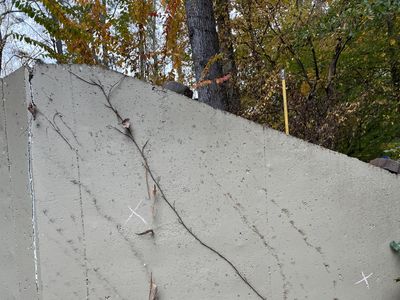
- Cracks running through the wall, vertical, horizontal, or stair-step
- Sections separating, shifting, or starting to slide apart
- Soil, water, or mud escaping through or over the top of the wall
Any one of these means the wall is moving. Several together mean it is moving faster.
Why retaining walls fail
The soil a retaining wall holds is heavy, and it gets heavier when it is soaked. That constant sideways pressure is what pushes a wall out of position, and it is made worse by the things most failing walls have in common: not enough drainage behind the wall, so water builds up and pushes; Georgia's expansive clay swelling against the back of it; and erosion washing out the soil at the base. Most walls that fail were never built with enough drainage or reinforcement to handle that load for the long haul.
How we fix it
We stabilize a failing retaining wall by anchoring it back to stable ground well behind the wall. Steel tie-back anchors run back to solid soil that is not moving, then get tensioned to hold the wall in place and, in many cases, pull it back toward straight. For walls that need more, we add steel reinforcement. It is a permanent fix that stops the movement, instead of patching cracks that will just open back up.
This is the same anchoring approach we use on seawalls and other walls holding back a heavy load. If your retaining wall is leaning or bulging, the time to deal with it is before it fails. See our retaining wall repair page for more.