Services
Retaining Wall Repair in Metro Atlanta
A retaining wall that is leaning, bulging, or cracking is losing its fight with the soil behind it, whether it holds up your yard or part of your home. We stabilize it with piers under the footing or with tiebacks anchored to stable ground, depending on the terrain. We repair walls, we do not build them.
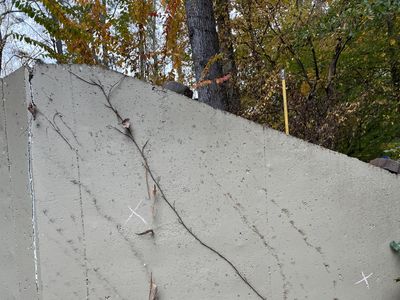
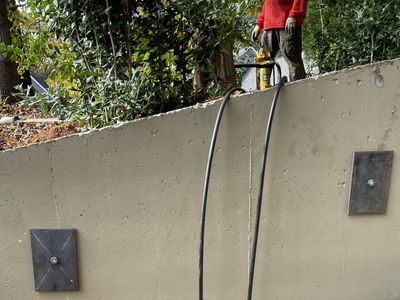
A retaining wall has one job: holding back the soil
When a retaining wall starts to lean, bulge, or crack, it's losing that fight, and the pressure behind it only builds with every heavy rain. Left alone, a failing retaining wall doesn't just get worse slowly; it eventually gives way all at once, and then it has to be rebuilt from the ground up. We stabilize it before it gets to that point. We repair the walls that hold up your yard and landscaping, and the ones that support part of the home itself.
Warning signs
- A wall that's visibly leaning or tilting away from the slope it holds
- Bulging or bowing in the face of the wall
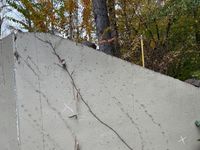
- Cracks running through the wall, vertical, horizontal, or stair-step
- Sections separating, shifting, or starting to slide
- Soil, water, or mud escaping through or over the wall
Why retaining walls fail
The soil a retaining wall holds back is heavy, and it gets heavier when it's saturated with water. That constant lateral pressure, made worse by poor drainage behind the wall, Georgia's expansive clay, and erosion at the base, is what pushes a wall out of position. Most walls that fail were also built without enough drainage or reinforcement to handle that load over the long term.
How we fix it
There is no single answer, because retaining walls fail for two different reasons and each one needs a different tool.
When the ground underneath the wall has settled, the wall is being carried by soil that will no longer hold it. We drive piers down through that soil to stable stratum and stabilize the footing, the same way we would under a settling house.
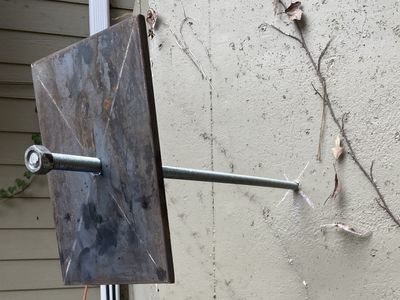
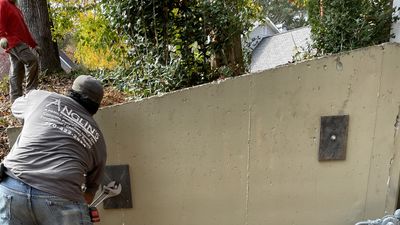
When the ground underneath is sound but the soil behind is pushing the wall over, we use tiebacks and sea wall anchors instead. Steel anchors tie the wall back to solid ground well behind it and are tensioned to hold it there. Holding the wall is the objective we commit to, and in a good many cases the tensioning also draws a leaning wall back a real distance toward straight. How much depends on the wall and the soil behind it, which is something we can judge on site rather than beforehand.
Which one is right depends on the surrounding terrain and on what the wall is holding up, and quite often it takes a look at the site to tell. That is what the free inspection is for. Either way it is a permanent fix that stops the movement rather than patching the cracks it caused.
We repair retaining walls, we do not build them. We will not lay you a new wall, and we do not rebuild one that has already come down.